Reviewing 50 Poverty Glyph Icons for Stitch Projects
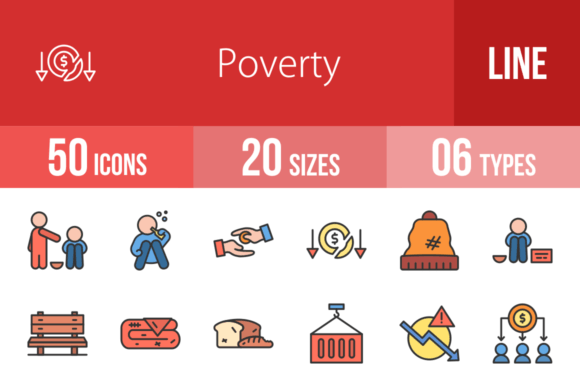
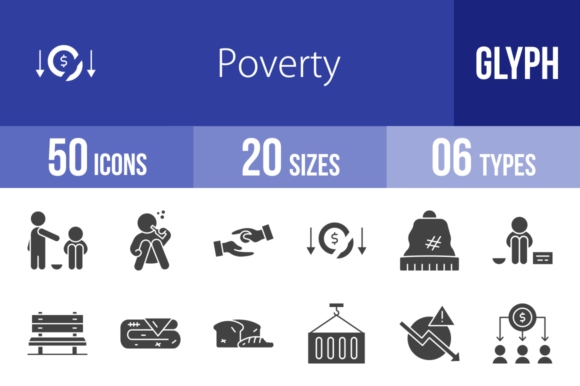
As a designer who spends half my life staring at screens and the other half hunched over an embroidery hoop, I have learned that not every digital asset translates well to thread. We often browse marketplaces looking for the perfect design assets, tempted by clean lines and modern aesthetics. Recently, I pulled up the 50 Poverty Glyph Icons pack to evaluate its potential for real-world application. My goal was not just to admire the pixels, but to determine if these graphics could survive the transition from vector file to tangible handmade product.
First Impressions and Visual Personality
The first thing you notice about this collection is its minimalism. These are glyph-style icons, which means they rely on solid shapes and negative space rather than intricate shading or gradients. For an embroidery designer, this is immediately promising. Complex gradients are a nightmare to digitize and often look muddy when stitched out. In contrast, the bold, flat nature of these Icons suggests they would convert cleanly into satin stitches or simple fill stitches.
The mood here is serious yet accessible. The theme of poverty awareness requires sensitivity, and the clean lines avoid being overly dramatic or cluttered. This visual personality fits naturally into projects aimed at raising awareness, charity drives, or educational materials. However, as a reviewer, I must ask: do they hold up under the needle? The simplicity is a double-edged sword. While it aids clarity, it demands precision. There is no place for sloppy digitizing when the design is this stripped back.
Real-World Application: The Tote Bag Test
To truly test the viability of these graphics, I imagined a specific client project: a run of custom tote bags for a local non-profit fundraiser. The client wanted something modern, recognizable, and durable. I selected three distinct icons from the 50 Poverty Glyph Icons set to mock up on a canvas tote bag design.
On screen, the icons looked crisp. But in embroidery, context is everything. I considered how these shapes would interact with the textured weave of canvas. Because glyphs are typically solid, they risk becoming dense blocks of thread. If the stitch density is too high, the fabric will pucker, and the bag will lose its structural integrity. If the density is too low, the underlying fabric might show through, breaking the visual impact. This is where the designer’s eye must intervene. I would recommend using a medium-weight cut-away stabilizer to support the stitch-out and prevent distortion on such a sturdy fabric.
Versatility Across Products
Beyond tote bags, I evaluated how these icons might perform on other common items. For sweatshirt embroidery, the soft fleece provides a forgiving background. The icons could work well as small chest logos or larger back prints. However, on stretchy fabrics, one must be cautious. A large, solid fill stitch can restrict the natural give of the garment. In such cases, converting parts of the icon to a running stitch or leaving strategic gaps for the fabric to show through might be necessary to maintain comfort.
For baby embroidery, such as on onesies or burp cloths, the scale becomes critical. These icons are likely designed for digital screens, where size is flexible. In embroidery, you are limited by hoop size and the physical limits of thread. Tiny details in a glyph can get lost or merge together when scaled down for a small item. I would advise testing these on scrap fabric at various sizes before committing to a final personalized gift or boutique item. A tiny icon on a baby cap needs to be bold enough to read from a distance but soft enough not to irritate sensitive skin.
Technical Considerations for Embroiderers
It is important to address the file formats provided. The description lists AI, CDR, EPS, JPG, and other formats. As an embroiderer, you cannot plug an EPS or JPG directly into your machine. These are vector and raster image files, respectively. You will need to use digitizing software to convert these Graphics into a proper machine embroidery design format compatible with your specific machine. This is a crucial step. Do not assume the download includes ready-to-stitch files like DST or PES unless explicitly stated. You are buying the visual source material, not necessarily the digital embroidery file ready for the hoop.
When digitizing these icons, pay close attention to corner sharpness. Glyphs often have hard angles. In stitching, sharp corners can cause thread breaks or bunching. Rounding off extreme points slightly in your digitizing software can improve the longevity of the finished product. Additionally, consider thread colors. High contrast is key. A dark icon on a dark shirt will vanish. Always test your design in black and white mockups first to ensure the shape remains legible regardless of color choice.
Commercial Use and Brand Consistency
For Etsy sellers and craft business owners, consistency is vital. Using a cohesive set like 50 Poverty Glyph Icons allows you to create a series of related products. Imagine a line of aprons, tea towels, and patches all featuring different icons from the same set. This creates brand recognition and professionalism. Customers trust shops that present a unified aesthetic. These icons can serve as the foundation for a themed collection, whether for holiday gifts, awareness campaigns, or educational tools.
However, always verify the licensing terms. Just because you purchased the graphics does not automatically grant you the right to sell unlimited physical goods without checking the specific license attached to the design assets. Ensure you are compliant before listing items in your small shop product inventory.
Final Verdict
The 50 Poverty Glyph Icons offer a strong starting point for designers willing to put in the digitizing work. They are not plug-and-play embroidery files, but they are excellent source material for creating custom appliqué design elements or stitched logos. Their strength lies in their clarity and modern appeal. With careful attention to stitch density, proper stabilization, and appropriate scaling, these icons can elevate a simple custom apparel piece into a meaningful, professional-grade item. Whether you are making a single embroidered patch for a friend or a hundred shirts for a cause, these graphics provide the visual backbone needed for impactful storytelling through thread.